Research
My main research area looks at the high-energy radiation environments around low-mass stars and how this impacts exoplanetary atmospheres. Beyond this, my interests range widely across stellar and exoplanetary astrophysics, from auroras on planetary bodies to asteroseismology of stars.
The UV and X-ray Activity of K Stars Across Time
Collaborators: Evgenya Shkolnik, Travis Barman, Victoria Meadows, Sarah Peacock, R.O. Parke Loyd, Adam Schneider, James Jackman
 A compilation of the results from HAZMAT I, III, V, and VI: median EUV (1–100 Å, blue), FUV (1340–1810 Å, red) and NUV (1687–3010 Å, black) fractional fluxes as a function of age for M and K type stars. Low-mass stars have increased levels of short wavelength emission that remain elevated for hundreds of millions of years while planets are forming their primary and, in some cases, secondary atmospheres.Image credit: Sarah PeacockThis research expands on the Habitable Zones and M-star Activity across Time (HAZMAT) program, which studies the ultraviolet (UV) and X-ray radiation emitted by low-mass stars over their lifetimes. This radiation is important because it can alter the chemistry and evolution of the atmospheres of planets orbiting in the habitable zone. Using GALEX photometry, HST spectroscopy, and Gaia distances, we trace how this high-energy radiation changes with a star's age, rotation, and Rossby number, considering both its steady (quiescent) and flaring behavior.
While K stars have recently been deemed as the best candidate stars to host “super-habitable” planets, our work has shown that this may not necessarily be the case. K stars experience similar levels of quiescent UV and X-ray flux as M stars and stay active for longer than early M stars. Comparing the two more directly, we find that although the intrinsic UV flux of an M star is 10–100 times lower than that of a K star, the UV flux reaching their respective habitable zones is similar. The X-ray picture is more distinct, with late M stars delivering several times more habitable-zone X-ray flux than K stars. In other words, the proposed K-dwarf advantage may not hold in the UV, though one may still exist in the X-ray.
Steady emission is only part of the story: UV flares can measurably reshape exoplanet atmospheres and, over time, even strip them away entirely. Flares from K stars have been far less studied than those from M stars, yet K stars are among the most common targets for the upcoming Habitable Worlds Observatory. Using HST spectra of 63 K stars spanning a range of ages, we characterized their UV flare activity and compared it to that of M stars. Young K stars (younger than a billion years) flare both more often and more energetically than their older counterparts, and their activity fades with age mainly through fewer, weaker flares rather than a change in the underlying flare physics. These measurements provide the K-star flare baseline needed to model the atmospheres of the planets that upcoming missions will characterize.
Papers:
Searching for Infrared Auroras on Exoplanets
Collaborators: Evgenya Shkolnik, Joe Llama, Peter Smith, James Sikora
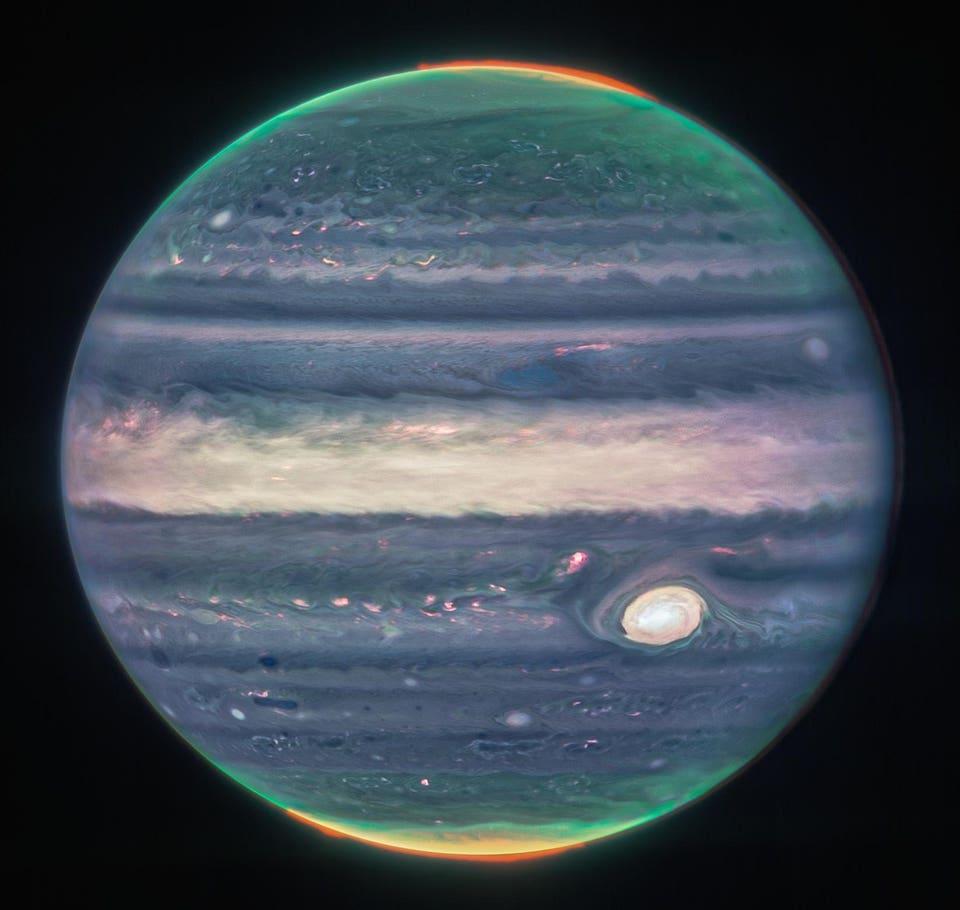 Jupiter, Saturn, and Uranus exhibit strong infrared auroras that regulate their atmospheric temperatures. It's likely that many exoplanets also have auroras.Image credit: NASA, European Space Agency, Jupiter Early Release Science team. Image processing: Judy SchmidtDetecting auroras on exoplanets would reveal a wealth of information about planet–star systems, including the strength of a planet’s magnetic field, the properties of its host star’s wind, and the thermal structure of its atmosphere. So far, however, no such auroras have been found. Here, we search for infrared auroral emission from H3+, a molecular ion that produces bright auroras in the atmospheres of the solar system giants Jupiter, Saturn, and Uranus.
Using high-resolution Keck/NIRSPEC spectroscopy, we looked for H3+ emission from two hot Jupiters, WASP-80b and WASP-69b. We found no significant signal from either planet, allowing us to place the most stringent upper limits to date on their auroral emission — limits that are beginning to approach the levels predicted by theoretical models.
Paper:
Brown Dwarfs: Are Radio Aurorae and O/IR Variability Connected?
Collaborators: Melodie Kao, Evgenya Shkolnik, Sebastian Pineda, Gregg Hallinan
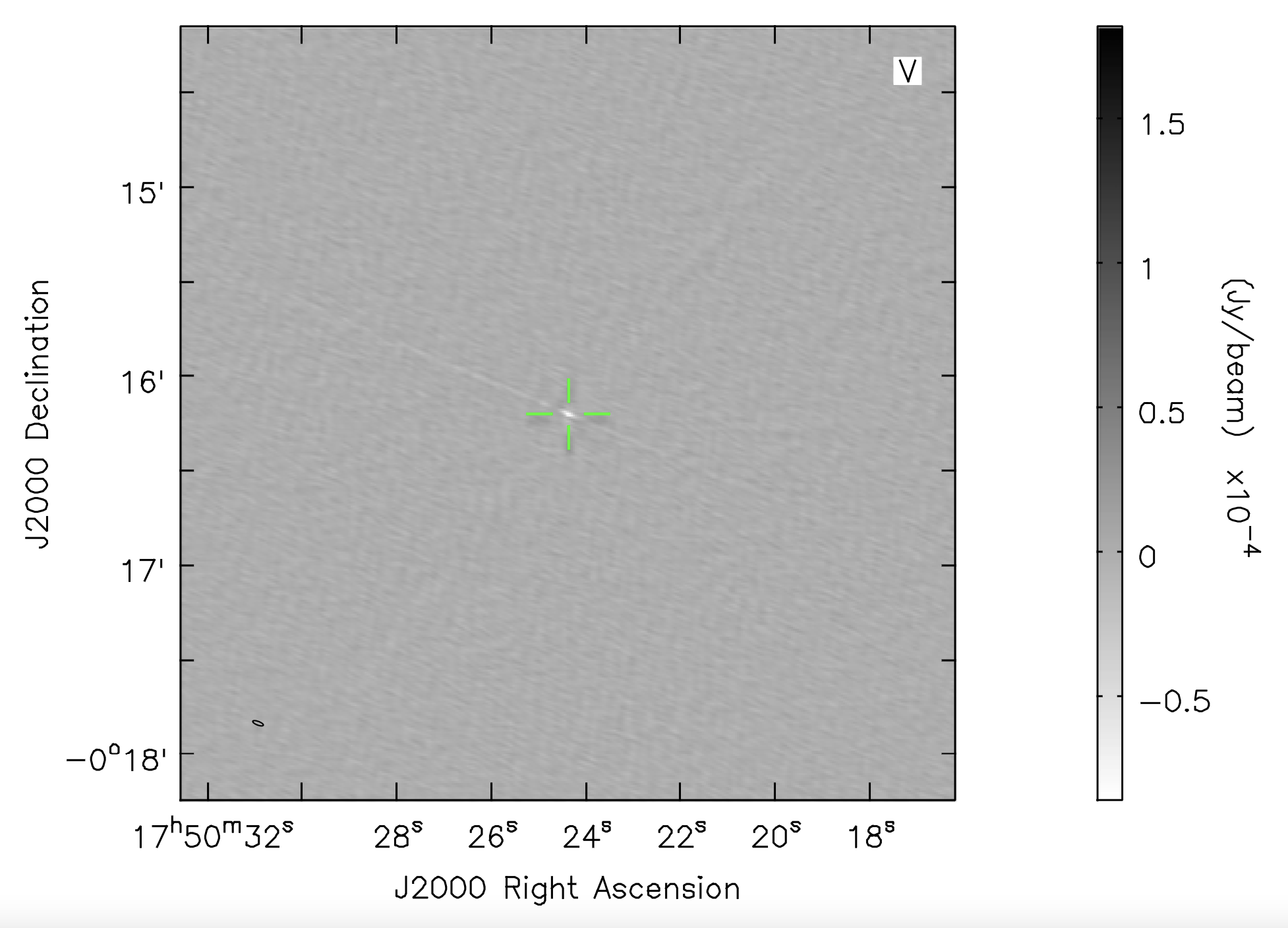 Discovery of a radio aurora on the brown dwarf 2MASS J17502484-0016151 in circular polarization. The emission spans the full frequency band with no cutoff, confirming a magnetic field strength of ≥2.9 kG.Optical and infrared (O/IR) variability is pervasive throughout light curves of L dwarfs as they reach the L/T transition. One hypothesis is that this variability is supplemented by localized magnetic heating due to aurorae. Using data from the VLA, we searched for radio emission in 17 photometrically variable L dwarfs from 4 – 8 GHz. We detected quiescent and highly circularly polarized flaring emission from only one source, inferring that auroral magnetic activity does not play a role in the O/IR variability observed on these targets. However, Hα emission may indeed be a tracer of magnetic activity.
Paper:
